


Captioning
Recently I invited two speakers to my class on Disability & Society to talk about employment and accommodation. They brought both professional expertise and lived experience with deafness. They discussed and demonstrated communication supports like ASL interpretation and various forms of captioning. For example, they opened an empty PowerPoint slide and turned on the live captioning feature, which allowed for their speech to be “captured” and projected in real time to the entire lecture hall. In addition, they turned on the Live Caption feature on a hand-held iOS device, which allowed them to also view live captioning while still facing their audience.
One of my favorite moments was when they asked the students how many of them were using the projected captions. Although none of the students had disability accommodations for captions, many students raised their hands. This observation aligned with survey results indicating that 50% of Americans watch content with subtitles “most of the time,” with rates tending to be higher for younger than older adults. Because captioning provides a more permanent/stationary record of what is said, it can support anyone who finds it helpful to have visual representation of speech. This can include, but is not limited to, people with hearing or attentional differences (e.g. deafness, adhd, autism), as well as people who have a different home language or dialect than the speaker.
Personally, I have had many a time in the middle of a lecture or meeting where my attention has drifted, and I find myself re-entering the dialogue mid-sentence wondering, “What did they just say?” My Autistic son who has very astute hearing started turning on captions during movies from a very young age. In addition to helping him process what was said, I believe access to captions helped him learn to read.
Curb Cut Effect
The widespread use of captioning is a great example of the curb cut effect, meaning accommodation for a specific disability group often leads to greater access for many more people than originally intended. The name comes from the small ramp (e.g., curb cut) routinely built into sidewalks. Curb cuts were mandated in the United States following the passage of the Americans with Disabilities Act in 1990. While intended to accommodate wheelchair users, the design facilitates access for a variety of people using wheeled devices (e.g., strollers, delivery carts, bicycles, luggage). Thus, the name curb cut effect emerged to describe how disability accommodations tend to increase access for people outside of the target group as well.
Competing Access Needs
Given the widespread use and “curb cut” potential of captioning, it is surprising to me that more movie theaters don’t routinely embrace captioning on the big screen. I suspect the answer is due in large part to ableism, but also to the possibility of competing access needs (aka, conflicting access needs). An access need is simply something a person needs to fully participate in an activity. Competing access needs describe situations in which two or more peoples’ access needs appear inconsistent with one another. For example, when someone with low vision needs bright lighting, and someone with migraines needs low lighting. Additional examples of competing access needs, as well as how they can be addressed, are available through this resource on Conflicting Access Needs by the Autistic Self Advocacy Network.
In my own household, my Autistic son often has multiple videos running at the same time, which helps him self-regulate. He will play a favorite video on his phone to distract him during the emotionally intense portions of a movie. For me, this “multichannel auditory experience” is dysregulating, especially if I am tired or have a migraine. When my son with Avoidant/Restrictive Food Intake Disorder (ARFID) was younger, peanut butter sandwiches were one of his safe foods that helped him get enough calories and some protein. However, peanut butter was banned from school at one point due to a student in his class with a peanut allergy.
Such examples of competing access needs often come up when talking about the goal of universal design, the concept of creating spaces that are accessible for as many people as possible without the need for specialized adaptions/accommodations. Discussing universal design often elicits the claim, “But meeting everyone’s needs isn’t possible.” While this is likely true for many situations, the statement often feels like a way for people to resist any change at all. My response is twofold: 1) even if universal accessibility is not attainable, that should not stop us from doing better, and 2) doing better requires us all to be more upfront in sharing our own access needs, as well as considering the needs of others.
Owning our Access Needs
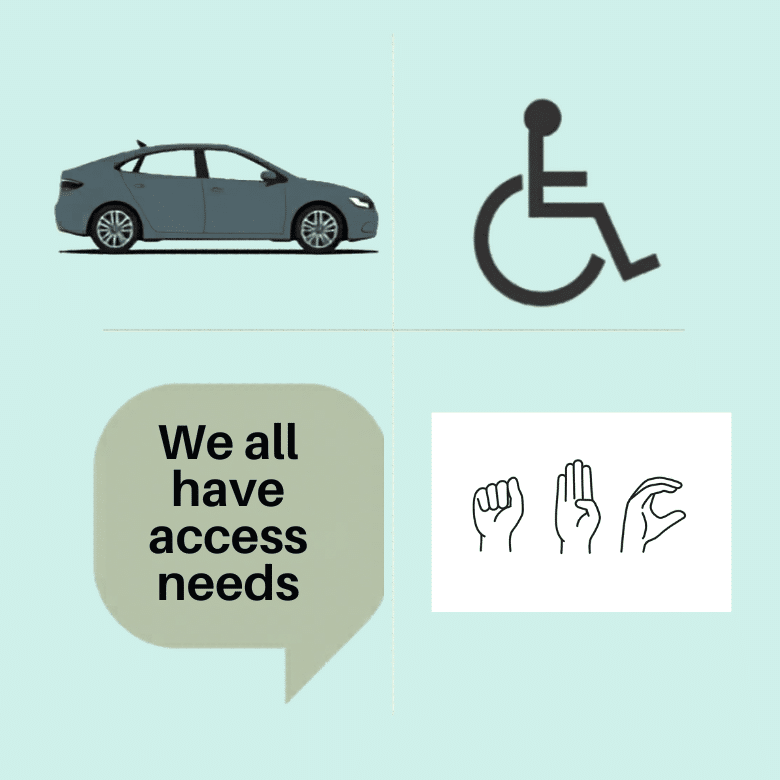
We all have access needs; they simply become invisible when those needs are built into our daily environments. For example, why is a wheelchair considered a mobility aid and a car isn’t? Both represent machines that help us get where we need to go. Why is the need for American Sign Language (ASL) viewed as an accommodation when the need for spoken English is not? Both languages are sophisticated linguistic codes, ruled by standardized grammars, and utilized to generate novel messages. The difference relates to which mobility aid(s), and which language(s), are built into society as “the default.”
If you need help understanding and envisioning what different environmental defaults might look like, I highly recommend watching this clever advertisement by Électricite de France, which provides a quick glimpse into a reimagined world built for those who use wheelchairs, ASL, and Braille. Real life alternative environments are also reflected in times and places where a specific difference became the norm, for example Martha’s Vineyard in regard to deafness and Island of the Colorblind in regard to colorblindness.
A few years ago, I had the privilege of attending a conference/retreat run for and by Autistic people. The venue prioritized varied aspects of autistic culture, such as the use of nonfluorescent lighting, multiple forms of communication, and color badges that reflected one’s receptivity to new social interactions. It was an enlightening opportunity to experience aspects of being a “neurominority” in an Autistic-led space. It helped me to experience autism more as difference than disorder.
Saying What We Need
The key then to navigating competing access needs is encouraging everyone to identify what their needs are, while also being receptive to the needs of others. Few of us are explicitly taught how to do this. And for people with disabilities, this form of self-advocacy is critical, but also complicated. Many people are hesitant to disclose their disabilities because of associated stigma. As one of our Deaf/HoH speakers shared: People prejudge you.
One of the ways to reduce such stigma, while advocating for accessibility, is to develop what one of our guest speakers called an “elevator pitch”—a practiced script that allows you to state your specific access needs (with or without disclosing a diagnosis). I got to see her put this advice to practice during our lunch afterwards when she asked the waitress to turn the background music down so that she could hear our conversation better. The other guest even advocated for my needs. She requested a different table away from the window, so that the direct sunlight would not trigger my migraines.
I recently came across additional examples by Autistic Blogger, Neurodivergent_lou. She recently shared on Facebook, “Steal these 11 Phrases to Ask for Adjustments without Disclosing that you’re autistic.” Her examples included:
- “I don’t use the telephone for phone calls so please text or email me instead”
- “I like to know what places look like in advance so if you have any photos, you could send me that would be really helpful.”
- “I struggle with remembering information so writing information down and being specific helps.”
- “I sometimes find people’s facial expressions difficult to read. This means I don’t always pick up on how someone is feeling from their facial expressions. Please be direct.”
One of my favorite examples of discussing access needs came from students in my class last year. One of the students approached me after class to confess that she had originally been annoyed by the ASL interpreters. She shared that their constant hand movements made it harder for her adhd brain to pay attention to what I was saying. However, she added that learning in class about ASL as a critical access need made her reflect on her annoyance and think creatively about how she could help herself by sitting somewhere else. This kicked off a positive discussion amongst the interpreters, the Deaf/HoH students, and the student with adhd about how they could all make adjustments to maximize accessibility.
Perhaps there is no such thing as an environment that can meet everyone’s needs, but if we aren’t talking about it, we will never find out how close we can get.
Notes:
Deaf/HoH refers to people with varied levels of hearing who identify as Deaf or Hard of Hearing (National Association of the Deaf, 2026)
Avoidant/Restrictive Food Intake Disorder (ARFID) is an eating disorder defined as the inability to get adequate nutrients and/or energy through food intake with an impact on at least one of the following: weight, nutrition, need for enteral feeding or oral food supplements, or psychosocial functioning. ARFID tends to be driven by limited appetite, aversions to sensory properties of food, and/or fear of a consequence of eating, such as choking. See my related post on ARFID for more information.